RAAS Dysregulation in POTS and Long COVID: A Distributed Neurovascular–Renal Control-System Model of Orthostatic Volume-Defence Failure

Updated: Sep 13
Dr Graham Exelby. Revised September 2026
Abstract
Background
Postural Orthostatic Tachycardia Syndrome (POTS) and Long COVID frequently demonstrate abnormalities of the renin–angiotensin–aldosterone system (RAAS), yet their physiological significance remains incompletely understood. Conventional endocrine protocols were designed primarily to identify autonomous aldosterone disorders and do not adequately assess dynamic neurovascular, renal and adrenal responses to orthostatic stress. Increasing posture-controlled observations suggest that the relevant abnormality is not confined to absolute renin or aldosterone concentrations.
Failure may occur at two coupled levels: haemodynamic/central-to-renal recruitment of renin, and downstream coupling of renin–angiotensin signalling to aldosterone output. Increasing observation of the latter phenotype raises a further, explicitly hypothesis-generating question: whether abnormalities of cerebral and hypothalamic–pituitary perfusion or pressure–flow relationships can degrade the timing and coordination of neuroendocrine volume defence. The resulting phenotype may therefore reflect loss of proportional control across a distributed neurovascular–renal–adrenal volume-defence system involving preload limitation, baroreflex integration, renal haemodynamics, hypothalamic–brainstem regulation, microvascular dysfunction, extracellular matrix vulnerability and metabolic signalling constraint. (1–18,40)
Increasing evidence suggests that orthostatic disorders are characterised not by isolated endocrine abnormalities, but by instability within a distributed neurovascular–renal volume-defence system involving preload limitation, impaired baroreflex integration, renal haemodynamic distortion, microvascular dysregulation, inflammatory amplification, extracellular matrix vulnerability, and metabolic signalling constraint. Emerging posture-controlled testing further suggests that impaired early renin proportionality represents a reproducible systems-level signature of loss of adaptive physiological amplification within this network. (1–18)
Objective
To characterise posture-dependent RAAS behaviour in POTS and Long COVID using a short-interval orthostatic protocol, and to examine renin proportionality and renin–aldosterone coupling as complementary physiological readouts of distributed volume-defence control.
Methods
Patients underwent posture-controlled RAAS testing following 30 minutes of supine stabilisation with repeat sampling at 3–5 minutes after standing. Renin and aldosterone responses were interpreted relative to orthostatic haemodynamic demand and within an integrated systems-physiology framework incorporating preload physiology, brainstem and hypothalamic autonomic regulation, renal haemodynamics, adrenal effector coupling, endothelial–pericyte signalling, inflammatory amplification, extracellular matrix/interstitial regulation and metabolic constraint. (1–7)
Results
In an expanding cohort (>70 patients), early renin non-proportionality remains frequent, but increasing sampling demonstrates a second important pattern: aldosterone output may be delayed, inadequate or physiologically uncoupled from renin recruitment and from the magnitude of orthostatic preload stress. Phenotypes therefore include early renin non-proportionality, orthostatic RAAS inertia, renin-suppressed failure, positional inversion, preserved renin with aldosterone dissociation, and mixed central–renal–adrenal failure states. The classical renin–aldosterone paradox described in POTS provides an important precedent for this interpretation. (8–18,40) Recurrent high-renin/low, static or falling-aldosterone responses are of particular interest because they indicate downstream coupling failure rather than simple failure to generate a renal renin signal.
These observations support assessment of orthostatic RAAS proportionality rather than isolated hormone concentrations. The relevant question is whether haemodynamic stress recruits an appropriately scaled renin response and whether aldosterone then scales appropriately to the upstream renin–angiotensin signal. Emerging evidence further suggests that both gains may be influenced by interacting central autonomic, renal haemodynamic, microvascular, inflammatory and hypoxia-responsive pathways. (8–18,31–40)
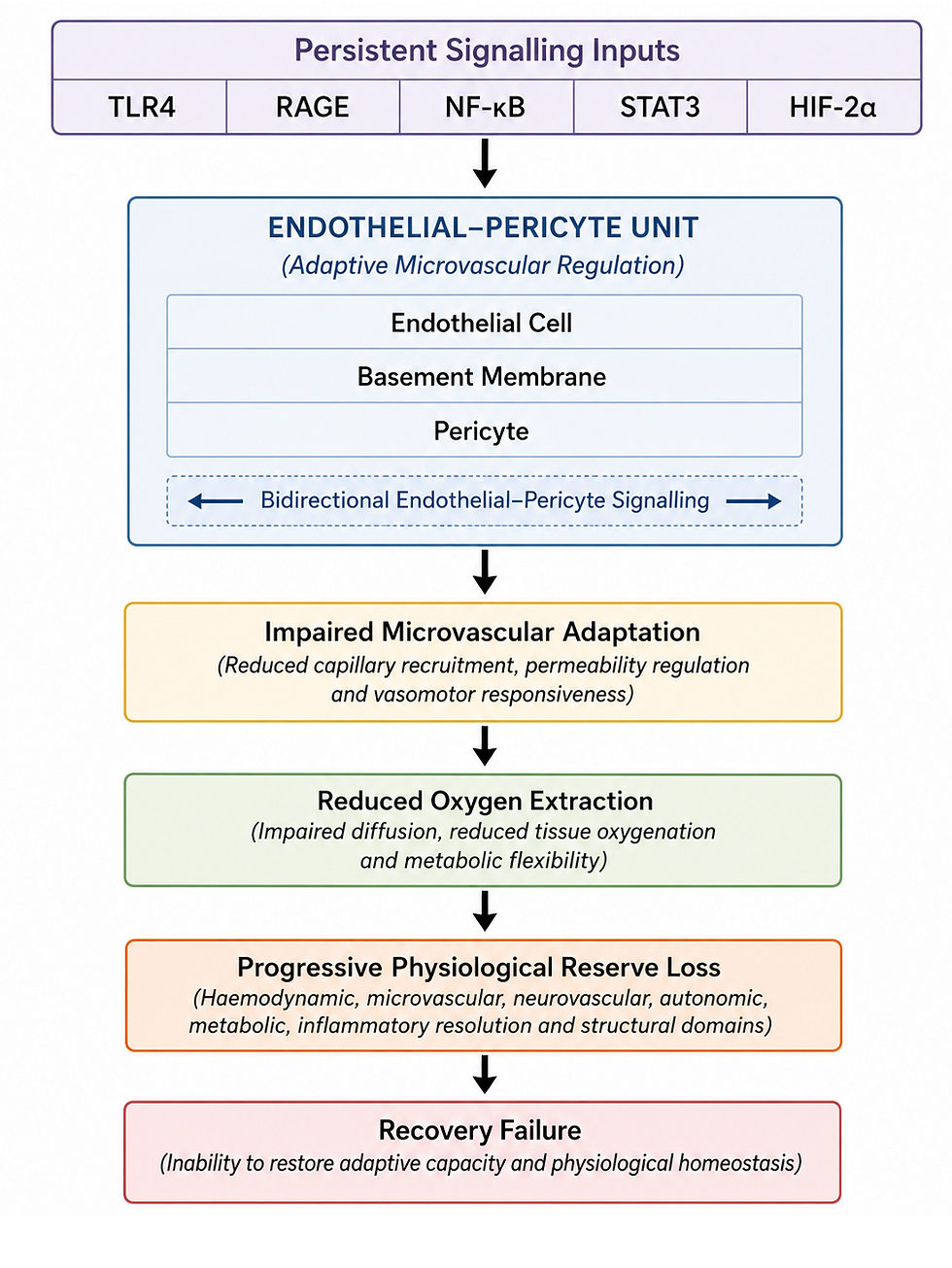
Emerging evidence further suggests that RAAS signalling fidelity may be strongly influenced by interacting metabolic, microvascular, inflammatory, and hypoxia-responsive pathways involving endothelial dysfunction, pericyte instability, extracellular matrix remodelling, mitochondrial dysfunction, intracellular hypoxia, and RAGE-mediated persistence amplification. (8–18,31–37)
Conclusion
RAAS abnormalities in POTS and Long COVID are best interpreted as manifestations of distributed neurovascular–renal–adrenal proportional-control failure rather than as a single endocrine lesion. Orthostatic preload limitation may initiate or amplify the disturbance, but central neurovascular dysregulation, impaired renal sensing and downstream renin–aldosterone uncoupling can each contribute to failure of effective volume defence. A central hydraulic–neuroendocrine contribution is proposed only as a testable hypothesis: disturbed cerebral or hypothalamic–pituitary perfusion/pressure–flow conditions may impair coordination of vasopressin, autonomic–renal and pituitary outputs without implying that the pituitary directly controls aldosterone.
Dynamic posture-controlled RAAS testing functions not simply as an endocrine assessment but as a physiological challenge test of control-system integrity. Renin proportionality reflects the fidelity of haemodynamic/central-to-renal recruitment, whereas renin–aldosterone coupling provides a second readout of downstream effector gain. Their combination may help distinguish predominantly central, renal-haemodynamic, downstream adrenal/angiotensin, medication-related and mixed phenotypes, with direct implications for management.
The data support the emerging hypothesis that chronic dysautonomia may represent persistence of maladaptive neurovascular amplification states arising from recurrent orthostatic stress, impaired signalling fidelity, endothelial–pericyte instability, and RAGE–NF-κB–STAT3-mediated inflammatory persistence.
Dynamic posture-controlled RAAS testing therefore functions not simply as an endocrine assessment, but as a physiological probe of distributed neurovascular control-system integrity within POTS, Long COVID, and related dysautonomic disorders.
Full paper below:
Comments