Visual Snow in POTS, Long COVID and Related Disorders

An Integrated Neurovascular, Cranial Hydraulic and Sensory-Gating Model
Graham Exelby
Abstract
Visual snow syndrome (VSS) is a neurological disorder characterised by the continuous perception of fine dynamic visual static across the visual field, commonly accompanied by palinopsia, photophobia, nyctalopia, enhanced entoptic phenomena, tinnitus and migraine.[1–4] Contemporary neuroimaging and electrophysiological studies support dysfunction extending beyond the primary visual cortex, with abnormalities involving extrastriate visual regions, the lingual gyrus, attentional and salience networks and cortical oscillatory organisation.[5–10] These observations establish VSS as a disorder of central sensory processing, but do not fully explain the physiological processes capable of initiating, amplifying or sustaining this abnormal network state.
An important clinical observation is that VSS and related positive visual phenomena may coexist with migraine, orthostatic intolerance, postural tachycardia syndrome (POTS), Long COVID, ME/CFS, tinnitus, dizziness, sensory hypersensitivity and head-pressure syndromes. In some patients, symptoms fluctuate with posture, exertion, heat, dehydration, sleep disturbance, cervical loading or post-exertional deterioration.
Objective studies in orthostatic-intolerance populations demonstrate that cerebral blood flow can fall substantially during orthostatic stress even when systemic blood pressure is maintained.[11–15] Whether this haemodynamic instability contributes directly to VSS has not yet been established.
We propose that, in a physiologically distinct subset of VSS, the perceptual disorder may emerge when several normally adaptive systems converge upon a common endpoint of unstable sensory gain and impaired suppression of endogenous visual noise. Potential contributors include impaired cerebral blood-flow reserve, altered cranial venous drainage, disturbed cerebrospinal fluid (CSF)–interstitial fluid dynamics, neurovascular-unit dysfunction, brainstem–hypothalamic autonomic instability, trigeminocervical sensitisation, neuroimmune activation, impaired metabolic reserve and altered excitation–inhibition balance.
Central to this model is the distinction between cerebral delivery and cranial drainage. Orthostatic reduction in effective venous return can decrease stroke volume and cerebral blood-flow reserve, whereas the cerebral venous system normally undergoes major posture-dependent redistribution between internal jugular and vertebral/paravertebral pathways.[16–21] Impairment of this compensatory architecture could theoretically alter cranial venous pressure gradients and interact with CSF and interstitial transport, although such a mechanism has not yet been demonstrated as a cause of VSS.
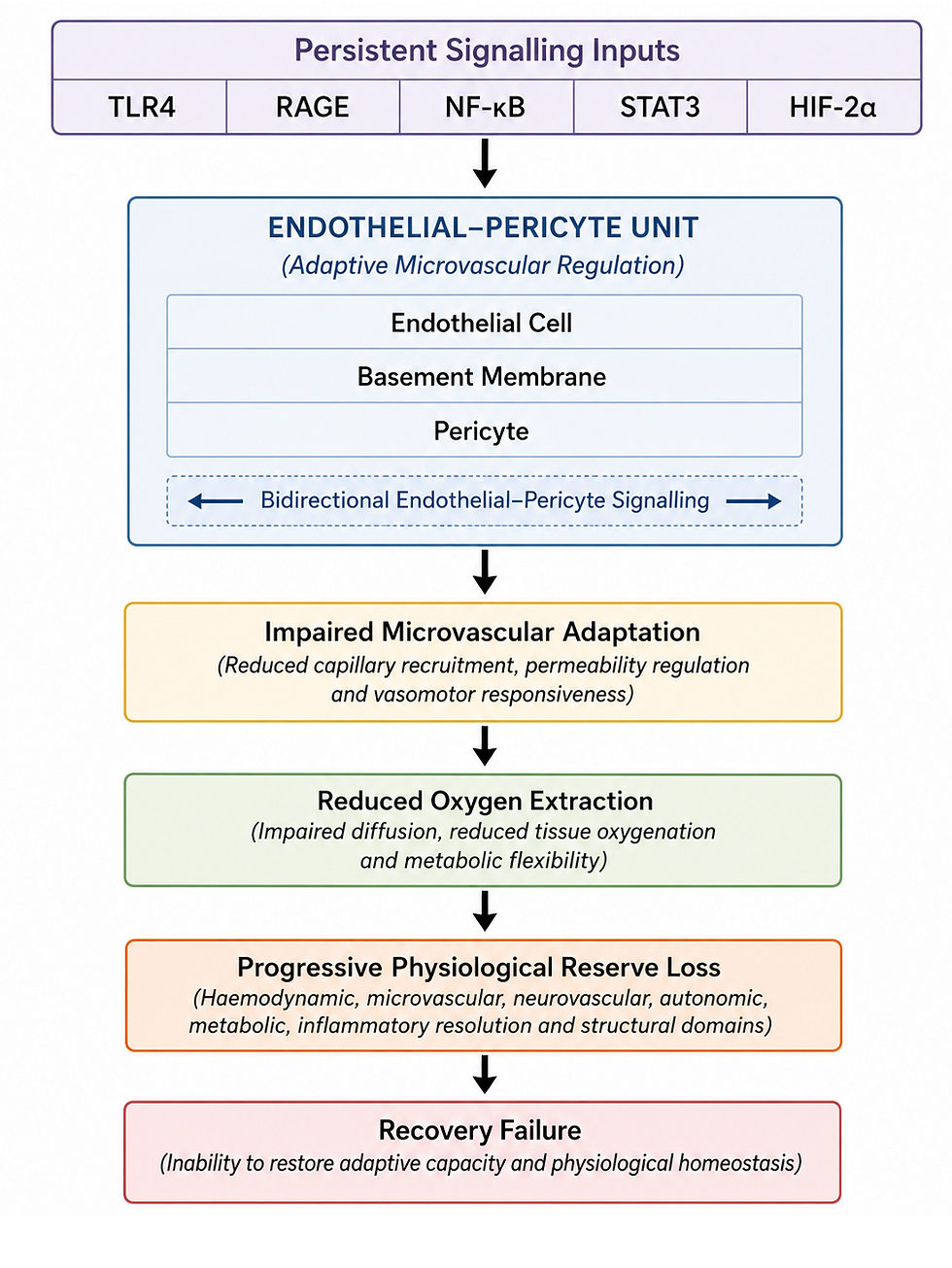
At tissue level, disturbances of perfusion, endothelial function and inflammatory signalling may affect pericytes, astrocytes, blood–brain barrier integrity, extracellular-matrix homeostasis and neurovascular coupling.[22–24] Long COVID is particularly relevant because BBB and neurovascular abnormalities have now been demonstrated in patients with persistent neurological symptoms.[25,26]
These processes ultimately converge upon brainstem, thalamic and cortical networks responsible for sensory gain. Destabilisation of noradrenergic regulation may interact with lateral geniculate, pulvinar and thalamic inhibitory circuitry, while altered cortical oscillatory control reduces suppression of normally subliminal neural activity.[8–10,27–29]
Visual snow is therefore conceptualised not as a direct marker of cerebral hypoperfusion, venous obstruction or neuroinflammation, but as a final perceptual phenotype arising when distributed visual networks lose sufficient capacity to distinguish meaningful visual signal from intrinsic neural noise.
The model generates testable predictions. It predicts that VSS subgroups should differ in their relationships with posture, cerebral blood flow, cranial venous dynamics, head pressure, migraine biology, cervical dysfunction and neurovascular/metabolic reserve. Identifying these physiological phenotypes may help explain why apparently similar visual symptoms arise through different mechanisms and why therapeutic response varies substantially between individuals.
Full paper attached below

Comments